Wood finish laminates give homes the warmth of natural timber with far greater consistency, durability and value than solid wood. Whether you are specifying kitchen cabinetry, wardrobes or a feature wall, a well-chosen wood finish laminate delivers the grain, tone and texture of real wood without the maintenance burden. This guide covers the styles available, how they compare to natural wood, and how to select the right finish for your project.
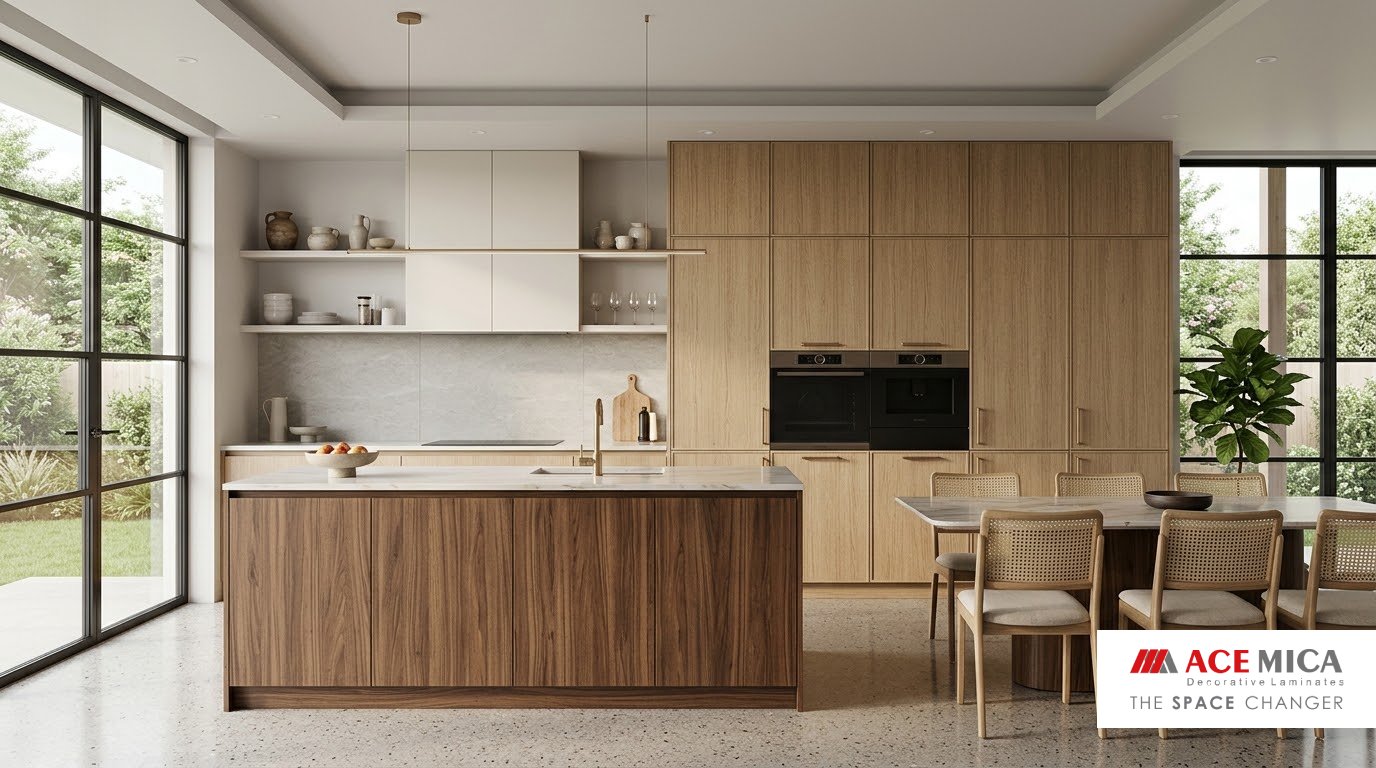
What Is a Wood Finish Laminate
A wood finish laminate is a decorative surface engineered to replicate the grain, colour variation and texture of natural timber using high-resolution printing and embossing techniques. The best wood finish laminates reproduce the subtle imperfections and grain flow of real wood closely enough that the surface reads as authentic from both a distance and up close.
Acemica’s wood finish range spans light oak and ash tones through to deep walnut and teak reproductions, giving designers a full spectrum of timber looks to match any interior style, from Scandinavian-inspired minimalism to warm traditional Indian interiors.
The embossing step is what completes the illusion of real timber. After the wood grain pattern is printed, the surface is pressed with a textured plate that matches the printed grain lines, so the laminate has a tactile groove structure that lines up with what the eye sees. This synchronised print-and-texture process is what separates a convincing wood finish laminate from an older-style flat printed surface.
Acemica sources its wood finish designs from real timber scans wherever possible, rather than generic computer-generated grain patterns, which is part of why the collection reads as genuinely natural rather than obviously synthetic once installed.
How Do Wood Finish Laminates Compare to Real Wood
Wood finish laminates offer far greater dimensional stability than solid timber, particularly in India’s variable humidity. Where real wood can expand, contract and warp with seasonal moisture changes, a quality laminate surface stays flat and stable across the year, protecting the substrate beneath it.
Cost and consistency are the other major advantages. Real wood grain and colour vary piece to piece, making it difficult to achieve a perfectly uniform look across a large run of cabinetry, while a wood finish laminate delivers the same grain pattern and tone reliably across every sheet, simplifying both design and budgeting.
Cost predictability is a factor many homeowners underestimate until they are deep into a project. Solid wood pricing can fluctuate with species availability and import costs, sometimes significantly during a project timeline, while laminate pricing stays stable and known from the outset, making budgeting for a full kitchen or wardrobe far more straightforward.
Sustainability is worth considering too. A wood finish laminate uses a fraction of the raw timber that a solid wood equivalent would require, since only the decorative surface layer references wood, not the entire panel thickness, making it a more resource-efficient choice for homeowners weighing environmental impact alongside aesthetics.
Which Wood Finish Styles Are Popular in 2026
Warm, natural oak and walnut tones continue to lead wood finish laminate trends in 2026, valued for their versatility across both traditional and contemporary interiors. These mid-tone woods pair easily with a wide range of wall colours and flooring choices, making them a safe and popular default.
Alongside these, richer teak and rosewood reproductions are trending for statement furniture pieces, while lighter Scandinavian-style ash and birch finishes are gaining ground in smaller apartments where a brighter, airier feel is the priority. Acemica’s catalogue covers all three directions within a single coordinated range.
Regional preference also plays into which wood tones perform best. In warmer, sun-drenched interiors common across much of India, mid-tone woods such as oak tend to balance the light beautifully without absorbing too much heat visually, while darker walnut and teak suit air-conditioned, more enclosed interiors where a cosier feel is the goal.
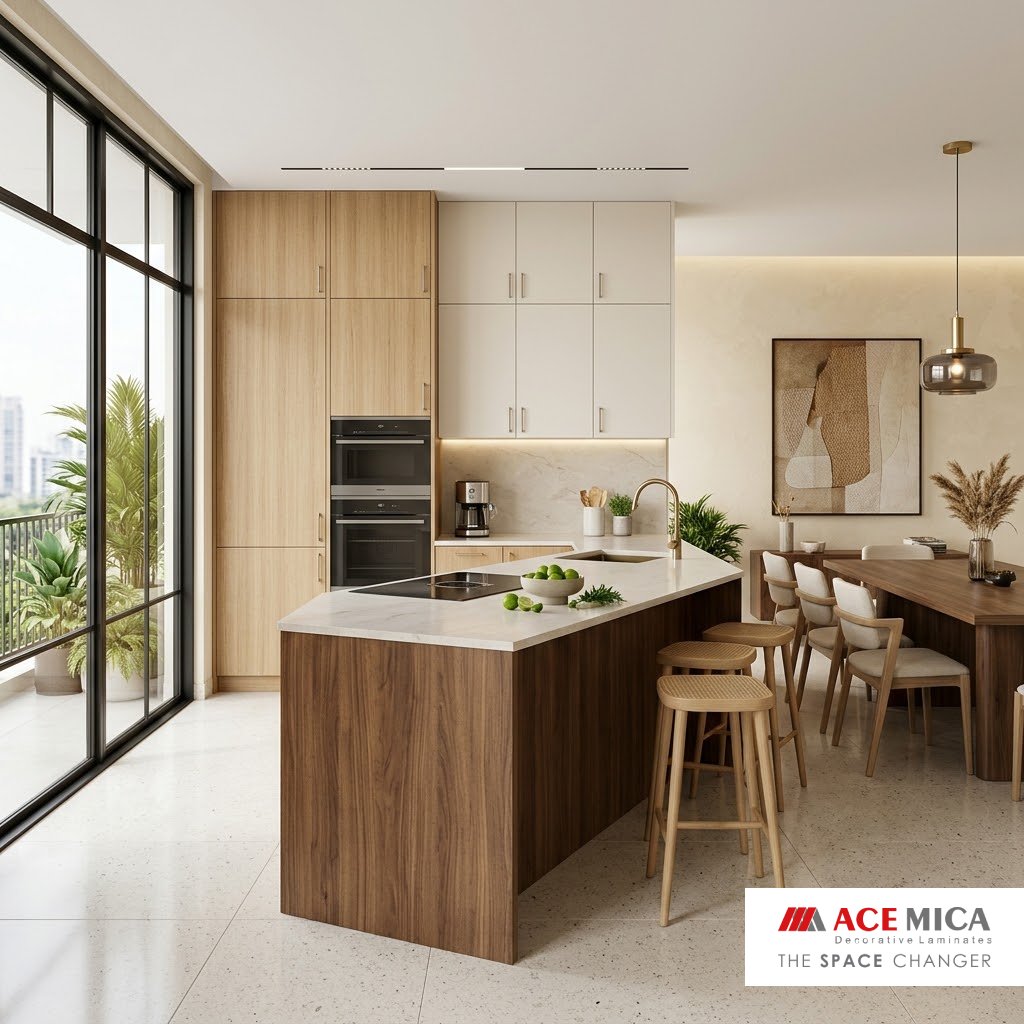
Two-tone wood pairings are also gaining traction in 2026, combining a light wood finish on upper cabinetry with a darker wood tone below, echoing a layout more commonly seen in premium European kitchen design and now being adapted for Indian kitchens through Acemica’s coordinated wood finish range.
Comparison Table: Wood Finish Laminate vs Solid Wood
| Factor | Wood Finish Laminate | Solid Wood |
|---|---|---|
| Dimensional stability | High, resists humidity changes | Can warp or expand seasonally |
| Consistency | Uniform grain and tone across sheets | Natural piece-to-piece variation |
| Maintenance | Wipe clean, no treatment needed | Periodic oiling or sealing required |
| Cost | Value to mid tier | Premium, varies by species |
| Durability | Resists scratches, colour stable | Can scratch, dent, and fade with sun |
| Design flexibility | Wide range of tones in one collection | Limited to available species |
How Do You Choose the Right Wood Finish
Consider the room’s lighting first. Warmer wood tones such as walnut and teak suit rooms with strong natural light, where the richness of the finish is fully visible, while lighter oak and ash tones help brighten rooms that receive less direct sunlight.
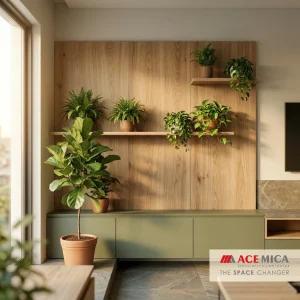
Also think about how the wood finish will interact with other materials in the space. A wood finish laminate paired with stone-look surfaces or metal hardware tends to look most current in 2026 interiors, and Acemica’s range is designed with these material pairings in mind across its collections.
Grain direction is a detail worth discussing with your fabricator before installation begins. Running the wood grain vertically on tall cabinetry, such as pantry units, versus horizontally on lower runs of cabinets, changes the visual rhythm of a kitchen considerably, and getting this consistent across a run of cabinetry is what separates a professional-looking installation from an amateur one.
Sampling under your kitchen’s actual lighting, rather than showroom lighting, remains the single best way to confirm a wood tone choice. LED under-cabinet lighting in particular can shift how warm or cool a wood finish appears compared to daylight, so viewing a sample at the time of day the kitchen will actually be used is worth the extra step.
Are Wood Finish Laminates Durable for Daily Use
Yes. A quality wood finish laminate is built to resist the scratches, scuffs and daily wear that furniture surfaces experience, while the printed and embossed grain pattern does not fade or wear away the way a stained wood veneer eventually can with sun exposure.
Maintenance is straightforward: a soft, slightly damp cloth keeps the surface clean, with no oiling, sealing or refinishing required, unlike solid wood furniture which typically needs periodic treatment to stay protected and looking its best over the years.
For families with young children, the practical case for wood finish laminate over solid wood becomes even stronger. Spills, scratches from toys, and general high-impact daily use are simply absorbed by a durable laminate surface without lasting damage, whereas solid wood furniture in a busy family home often shows wear within a few years that would require refinishing to correct.
Ultimately, the choice between a wood finish laminate and solid wood comes down to how much ongoing maintenance a household is willing to take on. For the vast majority of Indian homes, where humidity, daily use and budget all favour a low-maintenance option, Acemica’s wood finish range delivers the warmth of timber without asking for that ongoing commitment.
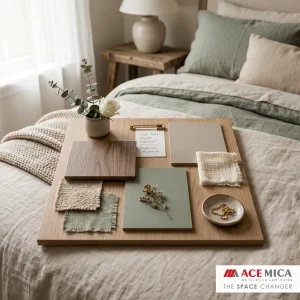
When budgeting a kitchen or wardrobe project, it is worth requesting samples of at least three wood tones side by side rather than choosing from a single swatch in isolation, since wood finishes in particular can look markedly different depending on what is placed next to them for comparison.
Acemica’s wood finish range is also designed to be extended over time, meaning a kitchen finished today in a particular oak tone can be matched later for an adjoining utility room or wardrobe, without the colour-matching difficulties that sourcing solid timber years apart would present.
Frequently Asked Questions
Do wood finish laminates look like real wood?
High-quality wood finish laminates closely reproduce the grain, colour variation and texture of real timber using detailed printing and embossing, and read as authentic from both close range and a distance.
Are wood finish laminates more durable than real wood?
In humid climates, yes. Laminates resist the warping and expansion that solid wood can experience with seasonal moisture changes, and the surface does not fade or need periodic refinishing.
Which wood finish laminate colours are trending in 2026?
Warm oak and walnut tones remain the most popular, with richer teak and rosewood reproductions trending for statement pieces and lighter ash or birch finishes gaining ground in smaller spaces.
Can wood finish laminates be used in kitchens?
Yes, wood finish laminates are a popular kitchen choice for cabinetry and islands, offering the warmth of timber with better moisture and stain resistance than natural wood in a kitchen environment.
How do I maintain a wood finish laminate surface?
A soft, slightly damp cloth is all that is needed for regular cleaning. Unlike solid wood, there is no oiling, sealing or refinishing required to keep the surface looking its best.
Call to Action: Explore Acemica’s full wood finish laminate range in the catalogue, spanning light Scandinavian tones to deep walnut, or contact the team to request samples for your project.