Laminates are made by soaking layers of paper in thermosetting resins, stacking them in a fixed order and fusing them into one hard sheet under heat and high pressure. The brown core is kraft paper treated with phenolic resin, and the visible face is a decor paper treated with melamine resin. Nearly everything a buyer cares about later, from shade match to how the sheet takes a knock, is settled at one of these stages.
What raw materials go into a laminate?
A laminate is made from paper and resin, and very little else. People are often surprised by that, because the finished sheet feels closer to a hard plastic than to anything that began as a paper roll.
- Kraft paper. A strong brown paper that forms the core. The number and weight of kraft layers set the thickness of the sheet.
- Decor paper. A printed or solid coloured paper that gives the laminate its design. Woodgrains, stones and abstracts are printed; plain colours use a paper that is coloured through.
- Overlay paper. A thin paper that turns clear when pressed. It sits over printed designs to protect the print from wear.
- Phenolic resin. The resin used in the core. It cures hard and gives strength and moisture resistance.
- Melamine resin. The resin used on the face. It cures clear and hard, which is why a laminate resists stains and scratches.
Acemica works with more than 1200 decor papers and over 150 textures, which shows how much of a laminate range is decided before a single sheet is pressed.
What are the steps in the laminate manufacturing process?
The laminate manufacturing process has eight steps, and each one hands a specific property to the next. A fault at any step travels all the way to the furniture.
- Resin preparation. Phenolic and melamine resins are prepared to a controlled recipe, because cure speed and flow in the press depend on it.
- Impregnation. Paper runs from the roll through a resin bath and then through a drying oven. Kraft takes phenolic resin and decor paper takes melamine resin. What comes out is called treated paper.
- Cutting and conditioning. Treated paper is cut to sheet size and held in controlled storage so it does not pick up moisture or dry out before pressing.
- Lay-up. Workers build each sheet as a stack: kraft layers at the bottom, decor paper above, overlay on top where the design needs it. The count of kraft layers decides whether the sheet becomes 0.8mm, 1mm or thicker.
- Pressing. Stacks are loaded between steel plates into a multi-opening hot press. Heat and pressure make the resins flow, bond the papers and then cure. This reaction is permanent, which is what “thermosetting” means.
- Cooling and release. The press cools under pressure so the sheets come out flat, and the plates are separated from the finished laminates.
- Trimming and sanding. Rough edges are trimmed to the final size and the back is sanded to give adhesive a surface to grip.
- Inspection and packing. Each sheet is checked for surface defects, shade and flatness, then graded, marked and packed flat.
What does each layer of a laminate do?
Each layer of a laminate does one job, and the sheet only works when all of them are present and properly cured.
| Layer | Paper used | Resin | What it does |
|---|---|---|---|
| Overlay | Thin clear overlay paper | Melamine | Protects the print from abrasion |
| Decor | Printed or solid colour paper | Melamine | Gives the design, colour and stain resistance |
| Core | Several layers of kraft paper | Phenolic | Gives thickness, strength and impact resistance |
| Back | Sanded kraft surface | Phenolic | Lets adhesive bond the sheet to the board |
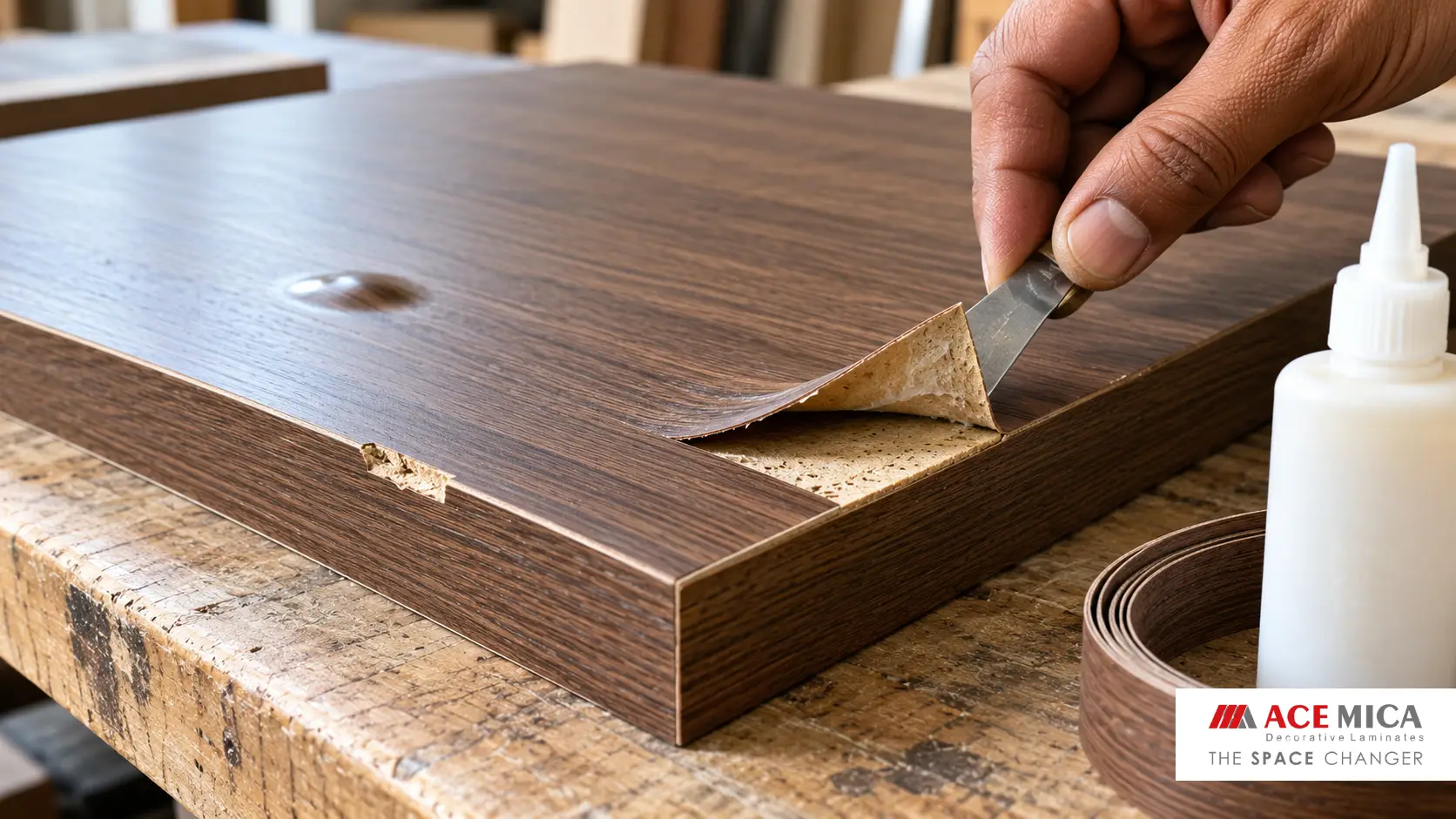
The brown line at the edge of a cut laminate is the kraft core showing through. That is normal and not a defect. It is also why edge band is used on shutters.
What does “high pressure” mean in a high pressure laminate?
High pressure means the sheet was consolidated in a press as a separate product before it ever met a board. That separates a high pressure laminate, or HPL, from a low pressure melamine surface, where a single decor paper is pressed directly onto particle board or MDF.
The difference shows in use. An HPL has a multi-layer kraft core behind the design, so it handles impact and wear better than a single paper pressed on a board. In India the product is covered by IS 2046, the standard for decorative thermosetting synthetic resin bonded laminated sheets, and in Europe by EN 438. When a specification names either standard, it is asking for a true high pressure laminate. Acemica manufactures its laminates at a factory at Dahegam in Gandhinagar district, Gujarat, and lists high pressure decorative laminates as its first product line.
How does the texture get onto the surface?
Texture is pressed into the laminate by the plate or release paper that sits against its face in the press. A mirror polished plate gives high gloss. A finely etched plate gives matt or suede. A deeply engraved plate gives the wood pores, linen weaves and stone grains that you can feel with a fingernail.
Because the finish is formed while the resin cures, it becomes part of the surface and is not a coating that can peel. It also explains why one design can be sold in several finishes: the decor paper stays the same and the plate changes. For how those finishes behave at home, see the comparison of high gloss and matte laminates.
Why can two sheets of the same design look slightly different?
Two sheets of the same design can differ slightly because they were made in different batches. Decor paper is printed in lots, resin is prepared in lots, and press conditions vary a little from one cycle to the next. Each variable is controlled within limits, and small differences can still add up to a visible shade shift when two batches sit side by side on one wardrobe.
The practical rule is simple. Order every sheet for a job together and ask for one lot. If you need a top-up later, take a cut piece to the dealer and match it in daylight before buying.
What should a buyer check that traces back to the factory?
A buyer should check five things, and every one of them points back to a manufacturing step.
- Even back sanding. A patchy back bonds unevenly and bubbles later.
- Flatness. A sheet that curls strongly when laid on the floor was not balanced or cooled well.
- Clean, tight edges. Layers that flake or separate at the edge suggest poor curing.
- Consistent thickness. Measure the edge with a vernier at more than one point; the reading should not wander across the sheet.
- A clean face. Specks, dull patches and dents come from dust or damaged plates in the press.
Are digital and metallic laminates made differently?
Digital and metallic laminates follow the same pressing process and differ in the decor layer. In a digital laminate the design is printed digitally instead of from engraved cylinders, which allows large non-repeating artwork and short runs. The post on digital laminates explains where they fit. A metal foil laminate carries a metallic layer at the face, so it is used as an accent and not on hard working horizontal surfaces.
Frequently Asked Questions
What paper is used to make laminates?
Laminates use kraft paper for the core, decor paper for the design and, on printed designs, a thin overlay paper on top. The kraft is treated with phenolic resin and the decor and overlay papers with melamine resin before pressing.
Is laminate made of plastic or paper?
A decorative laminate is mostly paper, bonded with thermosetting resins. The resins cure into a hard, rigid mass during pressing, which is why the finished sheet feels like a hard plastic even though its body is layered paper.
What is the brown layer in a laminate sheet?
The brown layer is the kraft paper core, treated with phenolic resin. It gives the sheet its thickness and strength. It shows as a thin brown line at cut edges, which is why shutters are finished with edge band.
What is the difference between HPL and LPL?
HPL is pressed as a separate multi-layer sheet under high pressure and then glued to a board. LPL, or low pressure melamine, is a single decor paper pressed directly onto the board. HPL has a kraft core behind the design and withstands wear and impact better.
Why is the back of a laminate sheet rough?
The back is sanded at the factory so that adhesive can grip it. A smooth, unsanded back would not bond properly to plywood or MDF. Even sanding across the whole sheet is a sign of careful finishing.
Understanding how a laminate is made turns a catalogue from a book of pictures into a set of decisions you can question. Acemica brings more than three decades of laminate manufacturing experience to that process. You can see the product lines on the Our Brands page, browse designs in the Acemica catalogue, or ask a technical question through the contact page.