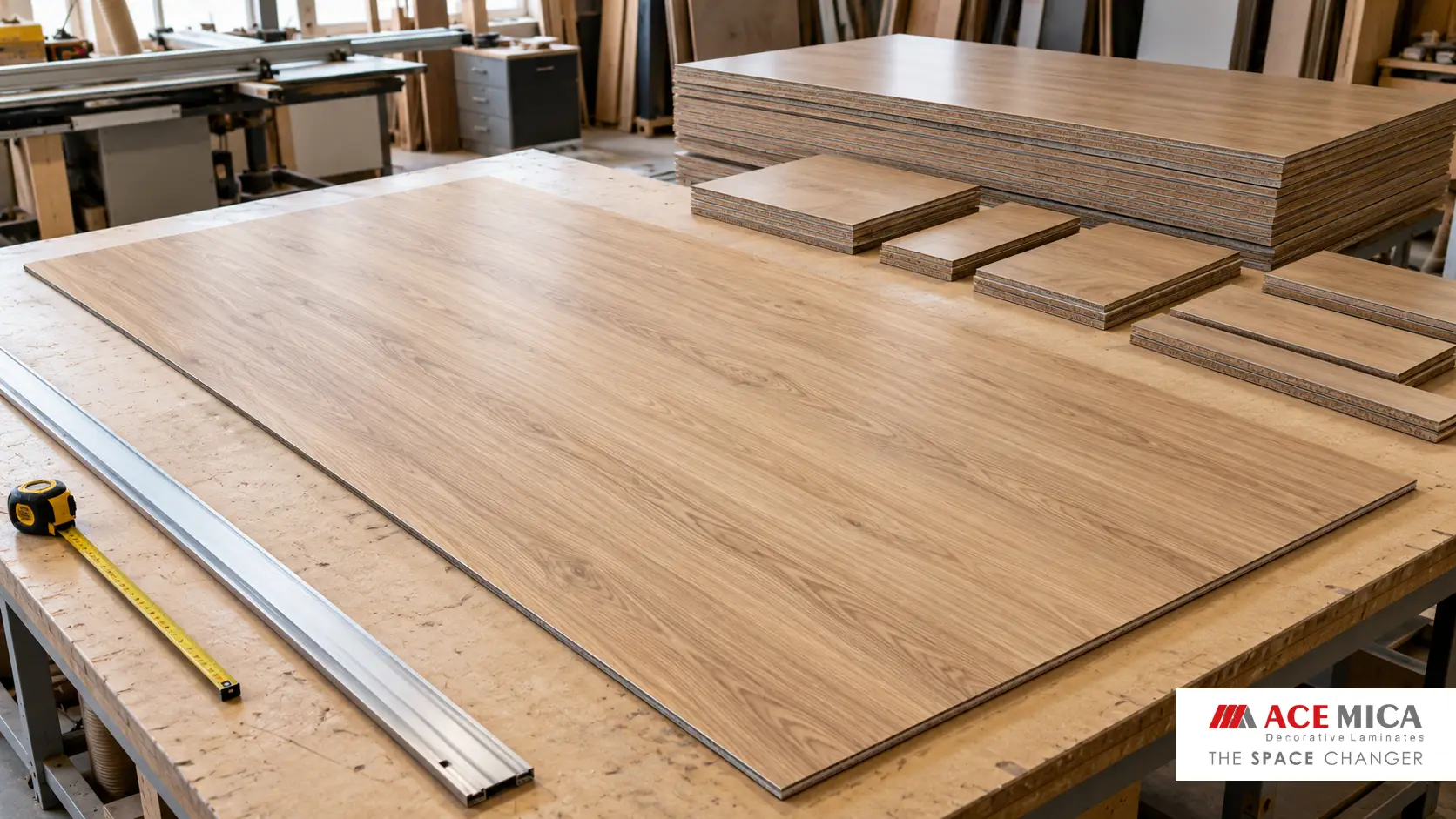
The standard laminate sheet size in India is 8 x 4 feet, which is 2440 x 1220mm and covers 32 square feet. A larger 10 x 4 feet sheet, 3050 x 1220mm, is used for tall wardrobes and full height panels, and door skins come in narrower door sized sheets close to 7 x 3 feet. Thickness is chosen separately from size, with 0.8mm and 1mm covering most furniture work.
What are the standard laminate sheet sizes?
There are five laminate sheet sizes in regular use, and they fall into two groups: furniture sheets and door sheets. Acemica lists all five on its product page, and they are a fair picture of what the Indian market works with.
| Size in mm | Approx size in feet | Area per sheet | Typical use |
|---|---|---|---|
| 1220 x 2440 | 4 x 8 | 32 sq ft | Standard furniture and panelling |
| 1220 x 3050 | 4 x 10 | 40 sq ft | Tall wardrobes, full height panels |
| 1300 x 3050 | 4.25 x 10 | 42.7 sq ft | Wide panels, partitions, cladding |
| 910 x 2130 | 3 x 7 | 20.9 sq ft | Door skins for standard doors |
| 990 x 2130 | 3.25 x 7 | 22.7 sq ft | Door skins for wider doors |
Dealers usually quote the length first and say “eight by four”. Factories and drawings usually write the width first in millimetres. Both describe the same sheet.
Why is 8 x 4 feet the default size?
8 x 4 feet is the default because plywood, MDF, particle board and blockboard are sold in the same size. One laminate sheet covers one face of one board with almost nothing left over, so the carpenter can press a full board and then cut components from it.
That match keeps the arithmetic easy. If a wardrobe needs six boards, it needs about six laminate sheets for the outer faces and six liners for the inner faces. It also keeps transport simple, since an 8 x 4 sheet fits a small tempo and goes up most staircases.
When should you choose a 10 x 4 sheet?
Choose a 10 x 4 sheet when a single surface is taller or longer than 8 feet and you do not want a joint across it. The common cases are these.
- Floor to ceiling wardrobes. Shutters of 8.5 to 9.5 feet cannot be cut from an 8 foot sheet without a horizontal joint.
- Full height wall panels. A panel that runs from skirting to ceiling looks cleaner in one piece.
- Long counters and reception desks. A 10 foot run in a single sheet has no visible seam.
- Partitions and cladding. Fewer joints mean faster fixing and fewer lines to align.
Two cautions apply. Not every design is made in the larger size, so check before the client falls in love with a sample. And a 10 foot sheet needs a 10 foot board under it, which affects board cost and handling. Acemica keeps a separate Brown Paper 10×4 catalogue, which is the quickest way to see which designs come in the longer sheet.
What size are door skin laminates?
Door skin laminates are made close to door size: 910 x 2130mm and 990 x 2130mm are the two sizes listed. In inches that is roughly 36 x 84 and 39 x 84. The height is just under 7 feet, which suits a standard flush door, and the two widths cover most internal and main doors with a small trimming margin.
A door skin is sized this way because its design is composed for one door, with borders or panels placed where a door needs them. Cutting it from a larger furniture sheet would waste material and misplace the pattern. The Door Skin catalogue shows how these designs are laid out.
What thickness options do laminate sheets come in?
Laminate sheets come in thicknesses from under a millimetre for furniture to 20mm for compact panels. Size and thickness are separate decisions, and most sizes are available in more than one thickness.
- 0.5mm to 0.7mm. Commonly used for liners inside cabinets, backing sheets and many door skins.
- 0.8mm. The general purpose furniture grade for homes and volume projects.
- 0.92mm. A middle step between 0.8mm and 1mm that some collections are made in.
- 1mm. The preferred grade for visible shutters, tables and textured designs. The 1mm vs 0.8mm comparison covers the choice in detail.
- 1.25mm. Chosen for heavy use and the deepest textures.
- 2mm and above. Compact laminates, which are thick enough to be used without a board behind them.
Acemica makes laminates across this whole span, from 0.5mm to 20mm, so the same manufacturer can supply the liner, the shutter face and the compact panel on one project. For how compact differs from a standard sheet, see compact laminates vs decorative laminates.
How do you calculate how many laminate sheets you need?
You calculate laminate sheets by counting components, not by dividing total area. Area alone gives a number that is always too low, because grain direction and offcuts decide how many pieces come out of a sheet.
Take a wardrobe 8 feet wide and 7 feet tall with four shutters, each 2 feet by 7 feet.
- List the visible faces. Four shutters of 2 x 7 feet and two side panels of 2 x 7 feet.
- Fix the grain direction. On a woodgrain the grain runs along the 8 foot length, so every 7 foot piece must be cut along the length.
- Nest the pieces on a sheet. A 4 x 8 sheet gives two pieces of 2 x 7 feet, with a 1 foot strip left at the end.
- Count sheets. Six pieces at two per sheet is three sheets of the outer laminate.
- Add liners. The inside faces need liner sheets, counted the same way.
- Add a margin. Keep one spare sheet on any job above five or six sheets. It covers a cutting error today and a repair two years from now.
By area alone, the six pieces come to 84 square feet, which suggests 2.6 sheets. The component count says three. On plain colours and non-directional designs you can rotate pieces and waste less. On woodgrains and linear textures you cannot.
Does sheet size change the price?
Sheet size changes the price per sheet but not always the price of the job. A 10 x 4 sheet costs more than an 8 x 4 sheet in the same design because it holds a quarter more material.
Where it replaces two cut pieces and a joint, the larger sheet can still be the cheaper route once labour and wastage are counted. Compare the two layouts before deciding. The laminate sheet price guide lists the other factors that move the rate.
Frequently Asked Questions
What is the size of an 8 x 4 laminate sheet in mm?
An 8 x 4 feet laminate sheet measures 2440 x 1220mm. It covers 32 square feet, or about 2.98 square metres. This is the standard furniture sheet in India and matches the size of plywood and MDF boards.
How many square feet are there in one laminate sheet?
A standard 8 x 4 feet laminate sheet has 32 square feet. A 10 x 4 feet sheet has 40 square feet. Door skin sheets are smaller, at about 21 to 23 square feet depending on width.
Are laminate sheets available in 10 x 4 feet?
Yes. Many laminates are made in 10 x 4 feet, which is 3050 x 1220mm, for tall wardrobes, full height wall panels and long counters. Not every design is produced in this size, so confirm availability for the exact design before planning around it.
What is the standard size of a door skin laminate?
Door skin laminates are commonly 910 x 2130mm and 990 x 2130mm, which is about 3 x 7 feet and 3.25 x 7 feet. Measure the door leaf itself, not the frame, and choose the width that leaves a small margin for trimming.
Can a laminate sheet be cut to size on site?
Yes. Carpenters cut laminate on site with a laminate cutter or a fine toothed saw and finish the edges with a trimmer after it is pressed to the board. The sheet should be supported flat while cutting so it does not crack.
Getting the size right at the planning stage saves a joint, a sheet or a return trip to the dealer. The full list of sizes and thicknesses is on the Our Brands page, and the longer sheets are shown in the Brown Paper 10×4 catalogue on the Brown Paper catalogue page. To check which size a particular design comes in, send the design name through the contact page.