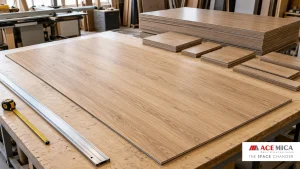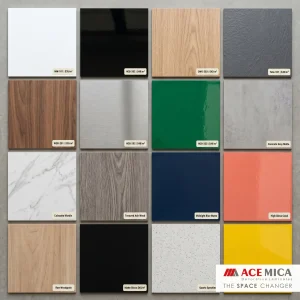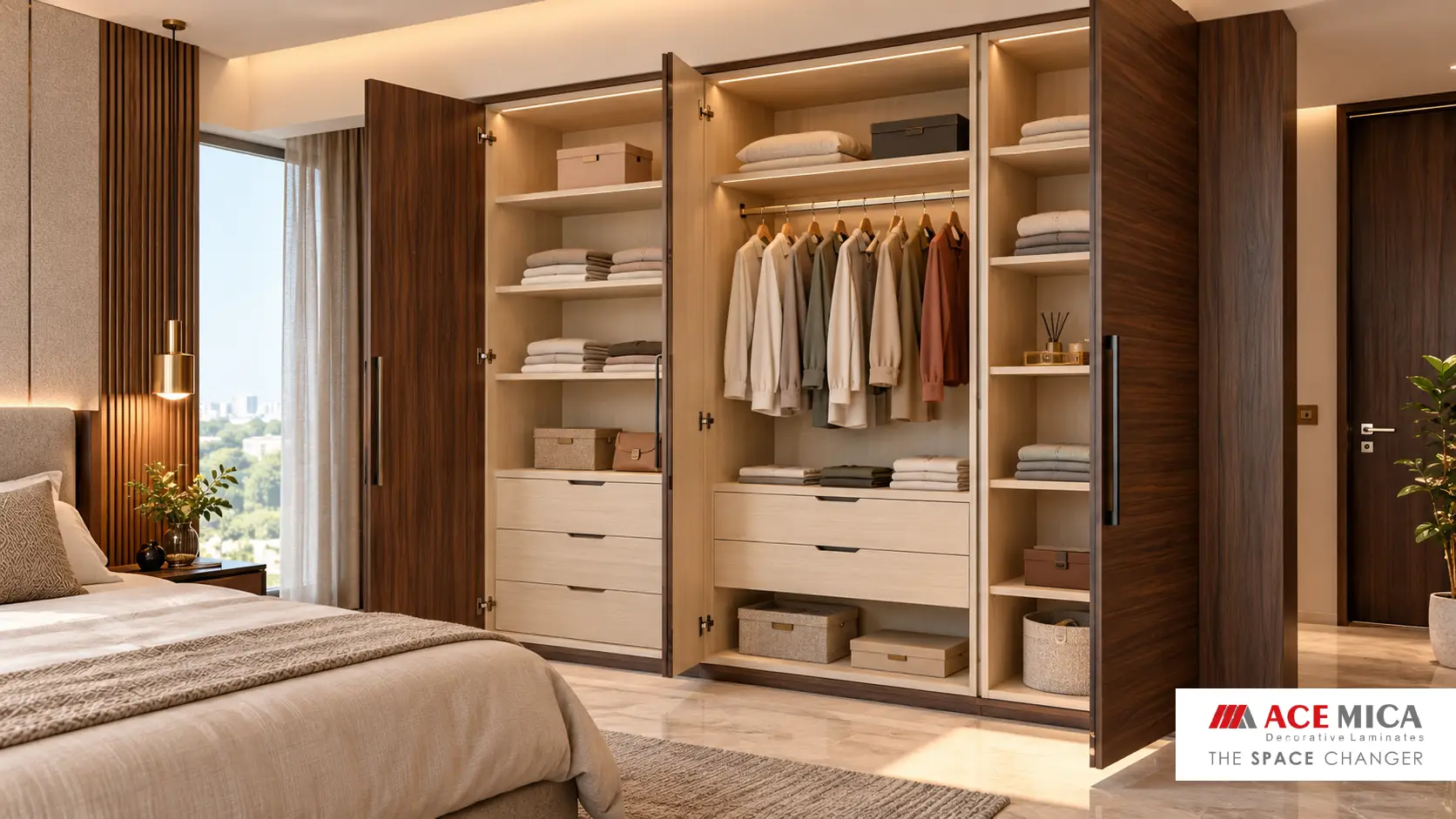
Solid colour laminates are decorative laminates in one uniform colour with no printed pattern, also sold as plain colour laminates or simply solids. They are used on modular kitchens, wardrobes, office furniture and any surface where colour, and not grain, carries the design. They look like the easy option, and they are in fact the least forgiving laminates to specify, because a plain surface shows every shade difference, fingerprint and rough edge.
What are solid colour laminates?
Solid colour laminates are high pressure laminates whose decor layer is a paper coloured in a single shade. A woodgrain laminate uses a printed paper. A solid uses a paper that is one colour throughout, which gives the flat, even tone that a print cannot.
The range runs from whites and off-whites through greys and pastels to deep navy, green, wine and black. Acemica groups its plain colours under a Solid category in the decor menu, shown on the site as Solids Plains, alongside Wood, Digital, Stone, Abstract and Metal Foil. You will hear the same product called plain laminate, plain mica or solid shade, depending on the city and the dealer.
Why are plain colours harder to get right than woodgrains?
Plain colours are harder because they have nothing to hide behind. A woodgrain has lines, knots and tone shifts that absorb small flaws. A flat colour puts every flaw on display.
- Shade variation. Two batches of the same grey can differ by a hair. On a woodgrain nobody notices. On a row of plain shutters it shows as one door looking newer than the rest.
- Board marks. Any unevenness in the plywood or MDF shows through a plain gloss surface as a ripple in the reflection.
- Fingerprints and dust. Dark plain colours show both, especially in gloss.
- Edges. The brown core line at a cut edge is far more visible against white or pastel than against walnut.
None of this is a reason to avoid solids. It is a reason to specify them with more care than a printed design needs.
How do you deal with the brown line at the edge?
You deal with the brown edge line in one of three ways: cover it, match it or design around it. The line is the kraft core of the laminate and appears wherever a sheet is cut.
- Use a matching edge band. A colour matched edge band covers the board edge and the laminate edge together. This is the standard solution for kitchens and wardrobes.
- Use a colour core laminate. In a colour core sheet the core is made in a colour close to the face, so a cut edge shows no brown line. Acemica lists Colour Core among its product types, and it suits counters, shelves and details where the edge is exposed and meant to be seen.
- Hide the edge in the design. Handleless profiles, shadow gaps and overlapping shutters keep cut edges out of the line of sight.
The edge is also where a white kitchen first looks tired, so it deserves a decision at the drawing stage and not on site.
Which finish suits a solid colour laminate?
The right finish depends on the colour and on how much the surface gets touched. Finish changes how a plain colour reads far more than it changes a woodgrain.
| Finish | How the colour looks | Fingerprints | Fine scratches | Good for |
|---|---|---|---|---|
| High gloss | Deep and reflective | Show clearly | Show clearly | Light colours, upper cabinets |
| Matt | Flat and calm | Show on dark shades | Less visible | Most shutters and wardrobes |
| Suede or soft texture | Soft with a slight grain | Largely hidden | Largely hidden | Dark colours, high touch areas |
| Deeper texture | Tactile and directional | Hidden | Hidden | Accent panels, commercial furniture |
A working rule: the darker the colour, the more texture it needs. A black gloss shutter is striking on day one and demanding from day two. The same black in suede keeps its depth and forgives daily handling. The longer comparison of high gloss and matte laminates covers the trade-offs room by room.
Which solid colours work where?
Light solids work as the base of a room and dark solids work as the accent. That one principle settles most colour arguments on a project.
Kitchens. White, ivory and pale grey keep a small kitchen bright and show less dust. A two tone scheme, with a darker colour on base units and a lighter one above, grounds the room and hides the scuffs that base units collect. Styling ideas are in solid colour laminates for kitchens.
Wardrobes. A plain colour on a floor to ceiling wardrobe makes it read as part of the wall. Soft greys, sand and muted greens are easier to live with than a strong colour across twelve feet of shutter.
Children’s rooms and study areas. This is where bolder solids belong, used in blocks: one drawer bank, one shelf back, one desk front.
Offices and shops. Plain colours let a business bring its brand colour into furniture and partitions, and they wipe clean easily. The guide to laminates for commercial spaces deals with wear in these settings.
Solids also pair well with woodgrains. A common split that works is about two thirds plain colour to one third wood, or the reverse, so that one material clearly leads.
How do you keep the shade consistent across a job?
You keep the shade consistent by controlling the batch, the light and the paperwork. Shade mismatch is the most common complaint with solids, and it is almost always preventable.
- Buy one lot. Order every sheet of a colour together and ask the dealer to supply from a single batch.
- Record the reference. Note the design code, finish and thickness on the drawing. “Light grey matt” is not a specification.
- Approve under site lighting. A grey that looks neutral in a showroom can turn warm under yellow LEDs or cool in north daylight. Look at the sample in the actual room, at the time of day the room is used.
- Keep one spare sheet. A spare from the same lot is the only reliable way to repair a damaged shutter later.
- Keep thickness the same on adjacent faces. Do not mix two thicknesses of the same colour on neighbouring shutters.
A visualizer helps before the sample stage. Acemica links each of its catalogues to the MySurface visualizer, where a colour can be placed on a kitchen or wardrobe to judge it against flooring and walls.
Are solid colour laminates suitable for commercial projects?
Solid colour laminates are well suited to commercial projects because they are consistent, repeatable and easy to maintain. A retail chain can specify one colour reference and get the same counter in every outlet. An office can run one neutral across workstations and bring colour in through storage fronts.
For large orders, confirm the available sheet sizes and thicknesses for the chosen colour early, and keep an approved control sample that both the site and the supplier can refer to.
Frequently Asked Questions
What is a solid colour laminate?
A solid colour laminate is a decorative laminate in one uniform colour without any printed pattern. It is also called a plain colour laminate. It is used on kitchen shutters, wardrobes, office furniture and panels where a flat, even colour is wanted.
Are plain colour laminates cheaper than printed laminates?
Plain colour laminates are often priced close to standard printed designs in the same thickness and finish. Price depends more on thickness, finish and collection than on whether the sheet is plain or printed, so special finishes and colour core sheets cost more.
Which finish is best for a white laminate kitchen?
Matt or a soft suede finish is the most practical choice for a white kitchen because it hides fine scratches and does not show every smudge. High gloss white looks brighter and suits upper cabinets that are touched less often.
How do you avoid the brown line on white laminate edges?
Use a colour matched edge band on every exposed edge, or choose a colour core laminate in which the core is close to the face colour. Careful trimming and a design that tucks edges out of sight also help.
Do dark solid colour laminates show scratches more?
Yes. Fine scratches, fingerprints and dust are more visible on dark plain colours, particularly in high gloss. Choosing a matt, suede or textured finish for dark shades reduces this considerably.
Plain colours reward the buyer who decides carefully and orders once. The full plain colour range is in the Solid decor gallery, and the product types, sizes and thicknesses are listed on the Our Brands page. To try a shade in a room first, open the MySurface visualizer.