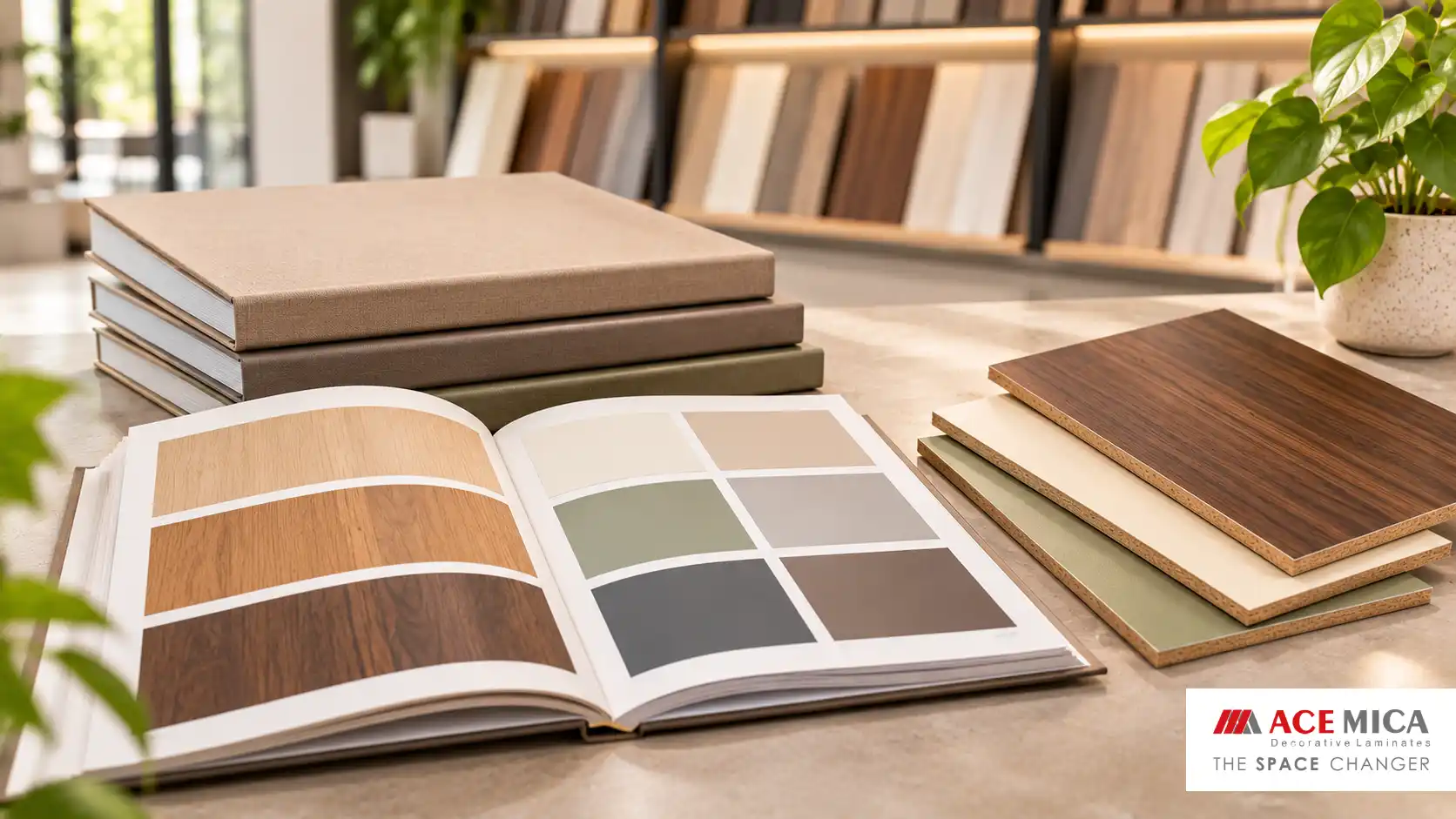
A brown paper laminate catalogue is organised into volumes, and the quickest way to browse it is to start with the thickness and the look you need, then open the volume that matches. Each volume groups designs of one thickness or theme, so you can compare like with like instead of scrolling through every design. This guide explains what brown paper laminate is, how the volumes are arranged and how to shortlist designs without wasting a site visit.
What is brown paper laminate?
Brown paper laminate is decorative laminate built on kraft-paper layers, the brown core that sits under the printed decor sheet. The brown layers give the sheet its strength, and the printed paper on top gives it the colour or wood grain you see. In trade conversation, “brown paper” also names a group of catalogue volumes, as distinct from other series such as Royal Gold.
For a buyer, the practical point is that brown paper volumes are where most furniture laminates are listed. If you are choosing for kitchens, wardrobes, tables or panels, this is usually the first catalogue to open. Our guide to brown paper laminates, applications and quality standards explains how the construction affects performance.
How are the brown paper volumes arranged?
The volumes are arranged by thickness and by theme, so each name tells you something about the designs inside. The Brown Paper catalogue on the Acemica site lists volumes such as Veneer, Louvers Collection, Digimax Collection, Arto and Platinum Collection Vol-VIII at 1mm, Silver Vol-IX at 0.92mm and Sawa at 1.25mm. The number in the name is the nominal thickness, and the word before it is the theme or series.
| Volume name | What the name tells you | Good starting point for |
|---|---|---|
| Veneer (1mm) | Wood-veneer look in 1mm | Wardrobe shutters, panels and furniture fronts |
| Louvers Collection (1mm) | Louvered and linear patterns in 1mm | Feature walls, TV units and partitions |
| Digimax Collection (1mm) | Digitally printed designs in 1mm | Statement surfaces and bold patterns |
| Arto (1mm) | Arto collection in 1mm | Browsing 1mm designs by theme |
| Platinum Collection Vol-VIII (1mm) | A numbered Brown Paper 1mm volume | Browsing a broad set of 1mm designs |
| Silver Vol-IX (0.92mm) | A silver-themed volume in 0.92mm | Surfaces that need a little more body than 0.8mm |
| Sawa (1.25mm) | The Sawa collection in 1.25mm | Heavy use and deeper textures |
Catalogue volumes are updated over time, so treat the names above as a snapshot and open the live catalogue for the current list. Other volumes on the page include Textile Collection Vol-I, Metcraft Vol-III, Marquise Collection Vol-IV, Vogue Collection, Cane Collection and Rangrez Vol-I. The page does not state their thickness, so read it from the catalogue PDF of the volume. Where a volume name carries a thickness, you can confirm the figure before you look at a single design.
How do you browse the catalogue step by step?
Browse in four steps: fix the thickness, pick the decor type, open the matching volume and shortlist three to five designs. This order keeps the list short and stops you from falling for a design that is not available in the thickness your surface needs.
- Step 1, thickness: decide 1mm for visible and high-touch surfaces, or a thinner sheet for interiors. The size and thickness guide helps with this.
- Step 2, decor type: choose between wood, solid, digital, stone, abstract and metal foil looks.
- Step 3, volume: open the volume that fits both choices and note the design codes you like.
- Step 4, shortlist: keep three to five codes, then ask for physical samples of those.
Write the design codes down as you browse. A code is the one detail that removes doubt later, when you ask for a quote, a sample or availability in a given size.
How do you match a volume to a room?
Match the volume to the job of the surface, then to the mood of the room. Kitchens need calm, easy-clean designs. Wardrobes can take wood grains and veneer looks. Living-room feature walls can carry louvered or digital designs that would be too much on every surface.
- Kitchen: solid and soft wood looks in 1mm. Read the kitchen laminate guide before you finalise colours.
- Wardrobe: veneer and wood-grain volumes, with a plain colour inside.
- Living room: louvered, fluted or digital designs on one feature wall or TV unit.
- Doors: door-skin sizes and designs. See the door skin laminates guide.
Do not decide from a screen alone. Colours shift between a monitor and a wall, and gloss, matte and textured finishes behave differently under room light. A sample held against the actual wall or cabinet settles the question quickly.
What should you note down while browsing?
Note the volume, the design code, the thickness and the finish for every design you shortlist. These four details travel with you to the showroom, the dealer or the carpenter, and they make quotes comparable. They also protect you when a project runs over several weeks and you need to reorder the same design.
It helps to photograph the page or save the link as well. If your project is large, also note the sheet size you want, because not every design is made in every size. The laminate quality checklist lists what to check when the sheets arrive.
How do you pair two designs from the catalogue?
Pair one expressive design with one calm design, and keep both in the same thickness family where they meet. A wood grain on the main shutters with a solid colour on the inner panels is a safe pattern. A louvered feature panel next to plain cabinets is another. For ideas on colour pairs, see the 1mm colour combination trends.
How do you read a design page in the catalogue?
A design page shows the design name or code, the volume it belongs to and an image of the surface. Use the image to judge pattern and tone, the code to identify it and the volume name to find its thickness. If a detail you need, such as the finish or sheet size, is not on the page, ask for it before you add the design to your shortlist.
Look at the scale of the pattern as well. A wood grain that looks fine on a small thumbnail can read as coarse or fine once it covers a full shutter. Many designers hold a physical sample at arm’s length to judge the scale, then step back to see how the pattern reads from across the room.
How do you compare two similar designs?
Compare them side by side at the same size, under the same light and against the same neighbouring colours. Two woods that look identical online can differ in warmth, grain direction or contrast once they are next to a wall colour. Place both samples against the wall or cabinet, photograph them in daylight and in evening light, and pick the one that holds up in both.
- Check warmth: is the tone yellow, red or grey?
- Check contrast: is the grain subtle or strong?
- Check direction: will the grain run vertically or horizontally on the shutters?
- Check finish: is it matte, suede, gloss or textured?
- Check availability: is it offered in the sheet size you need?
Acemica can share physical samples for your shortlist, so the final choice rests on what you can hold, not only on what you can see on a screen.
How often should you revisit the catalogue?
Revisit it at the start of every project, because volumes and designs are added over time and last year’s shortlist may be out of date. A design that was unavailable when you planned your last project may now be listed, and a volume you used before may have been replaced by a newer one. Save your design codes from each project, but check them against the live catalogue before you reorder.
It also helps to keep a small sample library at home or in the studio. A box of labelled swatches, with the code and volume written on the back, turns the next project into a ten-minute exercise: pull out the options, hold them against the wall and decide.
Frequently asked questions
What is a brown paper laminate catalogue?
It is the catalogue section for decorative laminates built on brown kraft-paper layers, arranged in volumes by thickness and theme.
What does the number in a volume name mean?
It is the nominal thickness of the sheets in that volume, for example 1mm in Veneer 1mm.
Can I order a design from any volume in any size?
Not always. Sizes can differ by design, so confirm the sheet size against the design code before you order.
How many designs should I shortlist?
Three to five is practical. It is enough to compare, and few enough to sample properly.
Should I rely on the online catalogue colours?
Use them to shortlist, then confirm with a physical sample in your own room light.
Open the Brown Paper catalogue to browse volumes, or the full catalogue to see every series. Other series are the Royal Gold catalogue, the Door Skin catalogue and the Flavors catalogue. For samples and design codes, write to Acemica through the contact page.