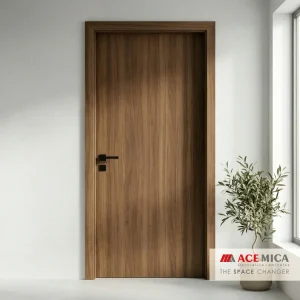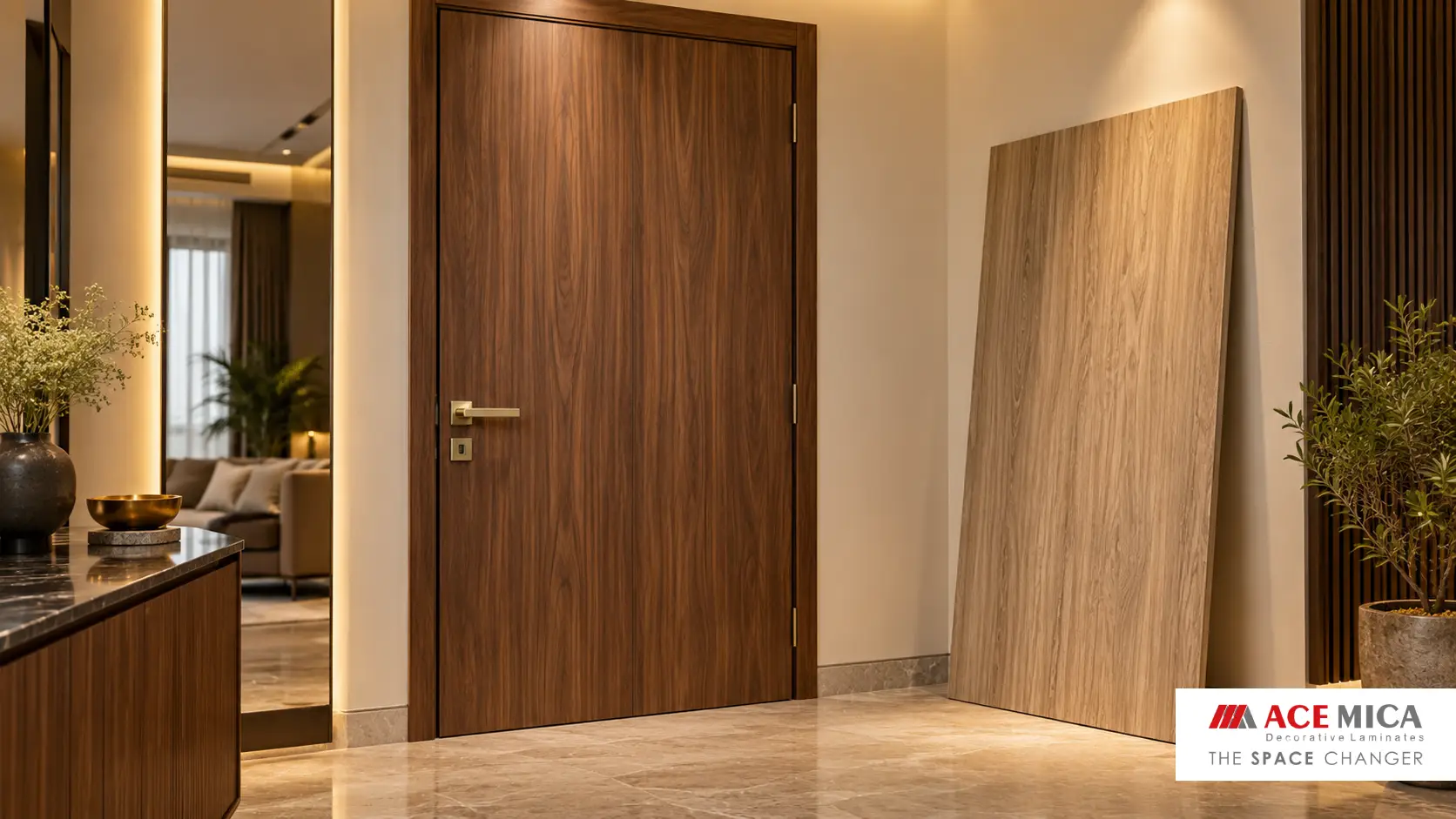
Door skin laminates are decorative laminate sheets made in door sized panels and pressed onto flush doors to give them a finished face. Each sheet carries a design composed for one door, such as a panel effect, a border, a groove pattern or a full woodgrain, instead of a pattern that repeats across furniture. They are the most economical way to give every door in a home or a project the same finished look.
What is a door skin laminate?
A door skin laminate is a thin decorative laminate cut to door proportions. It is built like any other laminate, with a decor paper over a kraft core, and it is glued to the face of a flush door in place of paint, polish or veneer.
One point causes regular confusion at the dealer’s counter. Two different products are called “door skin” in India. The first is the laminate door skin described here, a thin decorative sheet. The second is the moulded door skin, a pressed fibreboard panel with raised panel shapes that forms the face of a moulded door. They are not interchangeable. If you are finishing a flat flush door, you want the laminate kind. For the wider choice between door skins and full laminate sheets on doors, see the guide to decorative laminates for doors.
How is a door skin different from a regular laminate?
A door skin differs from a regular laminate in size, in how the design is laid out and in how it is bought. The material is the same family; the format is made for a different job.
| Point | Door skin laminate | Regular furniture laminate |
|---|---|---|
| Sheet size | About 3 x 7 or 3.25 x 7 feet | 4 x 8 or 4 x 10 feet |
| Design layout | One composed design per door | Continuous or repeating pattern |
| Typical thickness | Commonly thinner grades | Mostly 0.8mm to 1mm |
| How it is cut | Trimmed at the edges only | Cut into many components |
| How it is bought | Counted per door face | Counted per sheet |
| Where it goes | Flush doors | Shutters, panels, tables |
The layout is the real difference. On a furniture sheet you can cut anywhere. On a door skin, a border or a panel line sits at a fixed distance from the edge, so the sheet has to be centred on the door and trimmed evenly on both sides.
What types of door skin laminates are available?
Door skin laminates are grouped by the look they give the door. Four types cover nearly everything on the market.
- Woodgrain and veneer look. Teak, walnut and oak patterns, often with a darker border or an inlay line. The safest choice for homes.
- Panel and groove designs. Printed or textured designs that imitate a panelled or grooved door on a flat surface.
- Metallic designs. Door skins with metallic lines, motifs or accents, used on main doors and in hospitality projects.
- Digital and decorative prints. Bolder artwork for feature doors, children’s rooms or pooja rooms.
Acemica groups its door skins in a dedicated Door Skin catalogue, with ranges that include Brown Paper Door Skin, Brown Paper HZ Veneer Door Skin, Polo Metal Door Skin, La Mica Metal Door Skin and Royal Gold Metal Door Skin. Seeing them door by door is more useful than a small swatch, because the proportion of the design matters as much as its colour.
What size do door skin laminates come in?
Door skin laminates come in sizes close to a standard flush door. Acemica lists 910 x 2130mm and 990 x 2130mm among its sheet sizes, which is roughly 36 x 84 inches and 39 x 84 inches.
Three checks avoid a wasted sheet.
- Measure the door leaf, not the frame. Take the width and height of the shutter itself.
- Allow a trimming margin. The skin should be slightly larger than the door on every side so it can be trimmed flush after pressing.
- Check tall doors early. A door taller than 7 feet will not be covered by a 2130mm skin. For those, a 10 foot furniture laminate is the practical route, as explained in the laminate sheet size guide.
Where are door skin laminates used?
Door skin laminates are used wherever there are many flush doors and they need to look alike. Housing projects, hostels, hospitals, hotels and offices rely on them, because a painted or polished door costs more to finish and far more to keep consistent across two hundred units.
In a home they suit bedroom doors, study and store room doors, and the inner face of a main door. Bathroom doors are possible with care: the laminate surface handles splashes, but water that gets behind an unsealed bottom edge will swell the door core. The post on whether laminates are waterproof explains that distinction. An outer face that takes direct sun and rain needs an exterior rated product, not an interior door skin.
How do you choose a door skin laminate?
You choose a door skin laminate by settling size first, design second and finish third. Most mistakes come from doing it the other way round.
- Fix the size. Confirm that the door leaf fits within the skin with a margin to spare.
- Decide one design language for the house. Doors appear in every room and along every corridor. One family of designs, perhaps with a stronger one for the main door, reads calmer than a different pattern on each door.
- Relate it to the furniture. A door does not need to match the wardrobe. It should sit in the same tone range: warm woods with warm woods, greys with greys.
- Pick a forgiving finish. The area around the handle is touched hundreds of times a week. Matt and lightly textured finishes hide fingerprints better than gloss.
- Check the lock and handle position. Hold the handle against the design. A border or inlay line running through the lock plate looks like a mistake even when it is not.
- Order one lot for the whole job. Shade can vary between batches, and doors are seen side by side along a passage.
How is a door skin fixed to a door?
A door skin is fixed by spreading adhesive evenly on the door face, laying the skin, and holding it under uniform pressure until the adhesive sets. Door factories do this in a press. A carpenter on site does it with clamps, weights or a roller and patience.
Three details decide how long the door stays flat and clean.
- Skin both faces. A door laminated on one side only takes up moisture unevenly and can bow. Both faces should be covered, even if the inner design is plainer.
- Seal the edges. The four edges need lipping, edge band or at least a sealing coat, with special care at the bottom edge.
- Trim after curing. Trim the overhang once the adhesive has set, not before, so the edge does not lift.
Old doors can be re-skinned as well, provided the surface is flat, dry and sanded back to a sound base.
Frequently Asked Questions
What is a door skin?
A door skin is a thin decorative laminate sheet made in door size and glued to the face of a flush door. It gives the door its finished design and a surface that is easy to clean, in place of paint, polish or veneer.
What is the difference between a door skin and a laminate?
A door skin is a laminate made in door size with a design composed for a single door. A regular laminate comes in larger 8 x 4 or 10 x 4 feet sheets with a continuous pattern meant to be cut into furniture parts. Door skins are also commonly made in thinner grades.
What is the standard size of a door skin?
Common door skin sizes are 910 x 2130mm and 990 x 2130mm, which is about 3 x 7 feet and 3.25 x 7 feet. The size should be slightly larger than the door leaf so the edges can be trimmed flush after fixing.
Can door skin laminate be used on bathroom doors?
Yes, on the condition that the edges are sealed properly. The laminate face resists splashes and is easy to wipe, but water entering through an unsealed bottom or side edge can swell the door core. Seal all four edges and keep the door clear of standing water.
Can a door skin be applied on an old door?
Yes. An old flush door can be re-skinned if it is flat, dry and structurally sound. Old paint or polish should be sanded back so the adhesive can grip, and any dents should be filled level before the new skin is pressed on.
A door is the first surface a visitor touches, and it is worth choosing with the same care as the furniture behind it. Acemica also offers door skins under its Royal Gold range, so the door and the interior can be planned together. Browse the full set in the Door Skin catalogue, see the wider range in the Royal Gold catalogue, or request samples through the contact page.