Most decorative laminate sheets are water resistant rather than fully waterproof, which means they handle spills, steam and daily humidity well but are not built to sit underwater for long periods. Acemica laminates use a resin-treated surface layer that keeps moisture from soaking into the decorative face, though the plywood or particle board underneath still needs the right grade for wet areas to hold up long term. This guide walks through what waterproof actually means for a laminate sheet, where that distinction matters most in a home, and how to pair the right laminate with the right substrate.
What Waterproof Really Means for a Laminate Sheet
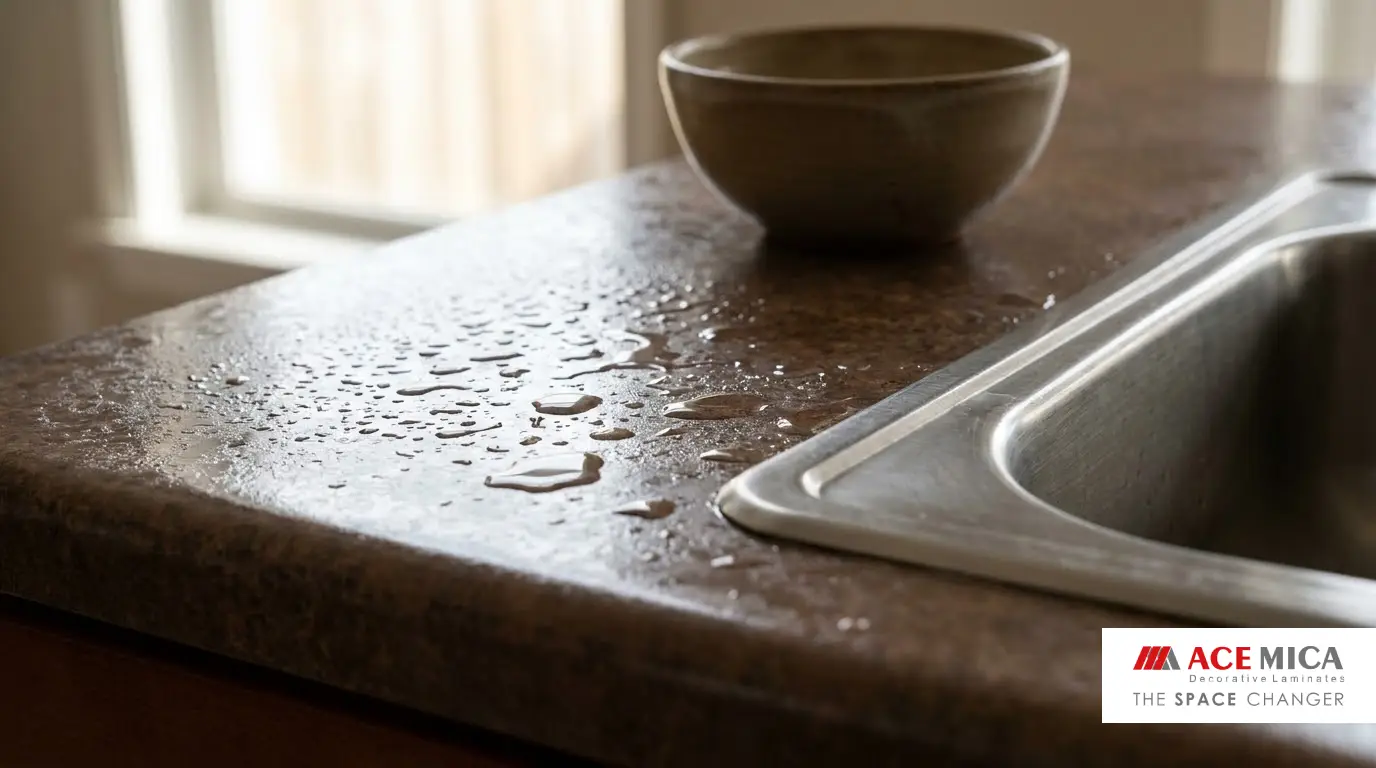
A laminate sheet is a thin, high-pressure layer bonded to a core board, and the sheet itself is genuinely resistant to surface moisture. Water that lands on the decorative face beads up or wipes away rather than penetrating the resin coating, which is why laminate countertops and cabinet fronts survive years of cooking splashes and wet cloths without swelling.
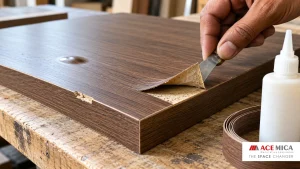
The real vulnerability sits at the edges and joints, not the flat surface. If water gets into an unsealed edge, a cut corner, or a gap around a sink cutout, it can reach the core board and cause swelling over time, regardless of how water resistant the top layer is rated.
Where Moisture Resistance Matters Most in a Home
Kitchens and bathrooms carry the highest moisture exposure, followed by utility areas, balconies and any furniture placed near a window that gets monsoon rain. In these zones, the combination of laminate grade and substrate matters more than in a living room or bedroom, where humidity is lower and spills are rare.
- Kitchen countertops and backsplash panels, exposed to daily splashes and steam
- Bathroom vanities and storage units, in near-constant humid conditions
- Utility area shelving, near washing machines and wet mopping zones
- Balcony or window-adjacent furniture, exposed to seasonal rain
How Acemica Laminates Perform Against Water and Humidity
Acemica manufactures its decorative laminates with a melamine-resin surface designed to resist staining, moisture absorption and everyday wear, which is why the Acemica range performs consistently well in Indian kitchen conditions where humidity swings widely across seasons.
The Brown Paper laminate line from Acemica adds an additional layer of surface durability that suits high-touch, high-moisture zones such as kitchen shutters and wet-area cabinetry, while the 1mm laminate sheets in the catalogue are the standard recommendation for any application where repeated cleaning and moisture contact are expected.
Choosing the Right Substrate for True Wet-Area Protection
The laminate sheet is only half of the moisture equation, and the core board underneath decides how the furniture actually behaves over years of use. Marine-grade or BWP-grade plywood, and moisture-resistant (MR) grade particle board, are the two substrate choices that pair well with laminate for kitchens and bathrooms.
Acemica recommends BWP-grade plywood as the core for any laminate application within two metres of a sink, shower or washing machine, since this substrate is specifically rated to resist water penetration at the board level rather than only at the surface.
Installation and Sealing Details That Prevent Moisture Damage
Edge banding is the single most important detail in a wet-area laminate installation, since every exposed cut edge is a potential entry point for water. A properly heat-sealed PVC or laminate edge band closes this gap and should be specified on every visible and hidden edge near a sink or counter.
Silicone sealant around sink cutouts, tap holes and where a countertop meets a wall adds a second layer of protection, and is a low-cost step that meaningfully extends the life of any laminate surface in a wet zone.
Signs of Moisture Damage to Watch For Early
The earliest sign of moisture reaching a laminate core board is usually a slight swelling or lifting along an edge, often near a sink cutout, tap hole or where two panels meet at a joint. Catching this at the first stage, while the laminate surface is still intact and only the edge has begun to soften, allows a simple re-sealing repair rather than a full panel replacement.
A second warning sign is a faint discolouration or darkening near an edge that was previously uniform in colour, which usually indicates moisture has already started to travel into the board from an unsealed gap. Acting on this early, by drying the area thoroughly and resealing the edge, prevents the swelling from progressing further into the panel.
Cabinets under a kitchen sink are the single most common location for this kind of gradual damage, since minor leaks from a tap or drain connection can go unnoticed for weeks. A routine check of the area under the sink every few months, alongside the annual edge inspection recommended elsewhere in this guide, catches most issues before they become expensive repairs.
A Practical Wet-Area Specification Checklist
Before finalising any kitchen or bathroom laminate order, running through a short specification checklist avoids the most common moisture-related callbacks a carpenter or contractor sees months after installation.
- Confirm the core board grade: MR or BWP for any surface within two metres of a sink or shower
- Specify laminate thickness by zone: 1mm for counters, 0.8mm acceptable for vertical low-contact panels
- Request heat-sealed edge banding on every exposed cut, not only the front-facing edge
- Plan silicone sealant application around every sink cutout, tap hole and wall junction before handover
- Ask the installer for a written note on which zones received BWP versus MR grade, for future reference
Comparing Costs: Prevention vs Repair
Specifying the correct core board grade and edge sealing at the outset typically adds a modest amount to the total cost of a kitchen or bathroom unit, usually a small fraction of the overall project budget once labour and hardware are included. Repairing a swollen laminate panel after moisture damage, by contrast, almost always means replacing the entire affected panel rather than a partial fix, since swelling changes the shape of the core board in a way that cannot be reversed.
This cost asymmetry is the strongest practical argument for specifying BWP-grade plywood and proper edge sealing on every wet-area surface from the start, rather than treating it as an optional upgrade. A homeowner who skips this step to save a modest amount upfront frequently ends up spending several times that amount within a few years replacing a damaged panel, along with the disruption of removing and reinstalling cabinetry around it.
For anyone renovating on a tight budget, a reasonable compromise is to specify the higher wet-area grade only for the zones directly adjacent to a sink or shower, while using standard grade elsewhere in the kitchen or bathroom where moisture exposure is genuinely lower. This targeted approach keeps costs controlled without leaving the highest-risk zones under-specified.
A Note on Warranty and What It Typically Covers
Most laminate warranties cover manufacturing defects such as delamination under normal use, but explicitly exclude damage caused by standing water, improper edge sealing, or use of abrasive cleaners against manufacturer guidance. Reading the warranty terms for the specific Acemica product line being used, before installation begins, clarifies exactly which moisture-related scenarios are covered and which depend on correct installation practice.
Moisture Resistance Comparison: Laminate and Substrate Combinations
| Combination | Surface Water Resistance | Best Use | Relative Cost |
|---|---|---|---|
| Standard laminate + regular plywood | Good on surface, weak at edges | Living room, bedroom furniture | Lowest |
| Acemica 1mm laminate + regular plywood | Very good on surface, moderate at edges | Dry kitchen zones, wardrobes | Low-Medium |
| Acemica 1mm laminate + MR-grade board | Very good, improved edge tolerance | Kitchen shutters, utility units | Medium |
| Acemica Brown Paper laminate + BWP plywood | Excellent, edge and surface protected | Sink counters, bathroom vanities | Medium-High |
Frequently Asked Questions
Can laminate sheets be used directly on a bathroom wall?
Yes, provided the laminate is bonded to a moisture-resistant substrate and all edges are properly sealed. Direct wall application without a sealed edge is not recommended in constantly wet zones such as the area directly inside a shower enclosure.
Will a laminate kitchen countertop swell if water sits on it overnight?
A short period of standing water on the surface will not damage a properly sealed laminate countertop, but water that pools near an unsealed edge or seam for extended periods can eventually seep into the core board and cause swelling.
Is Acemica 1mm laminate suitable for a modular kitchen in a humid coastal city?
Yes, Acemica 1mm laminate is a common specification for coastal and high-humidity regions when paired with MR-grade or BWP-grade board, since the resin surface resists the constant ambient moisture typical of these climates.
What is the difference between water resistant and waterproof laminate?
Water resistant laminate repels surface moisture and short-term spills, while a fully waterproof system would need to withstand permanent submersion, which standard decorative laminate sheets are not designed for. For genuinely wet applications, pairing laminate with a BWP core and sealed edges is the practical waterproofing approach.
How often should edge sealant be checked on a kitchen laminate countertop?
Checking the sealant around sink cutouts and counter edges once a year, and resealing if any cracking or gaps appear, prevents the most common cause of moisture damage in laminate kitchen installations.
Get Started with Acemica
Acemica offers a full range of moisture-resistant laminate sheets suited to kitchens, bathrooms and utility spaces across India. Browse the complete laminate catalogue or get in touch with the Acemica team to select the right laminate and substrate combination for your project, and to confirm the correct edge-sealing approach before installation begins.
Explore the Brown Paper laminate catalogue, our full laminate sheets guide and the Acemica team to plan your next project.