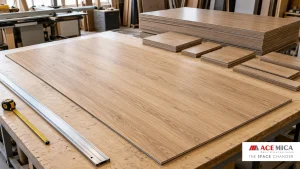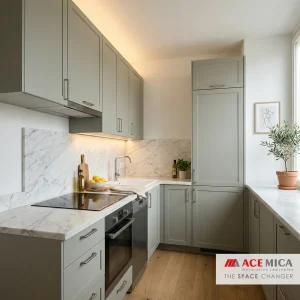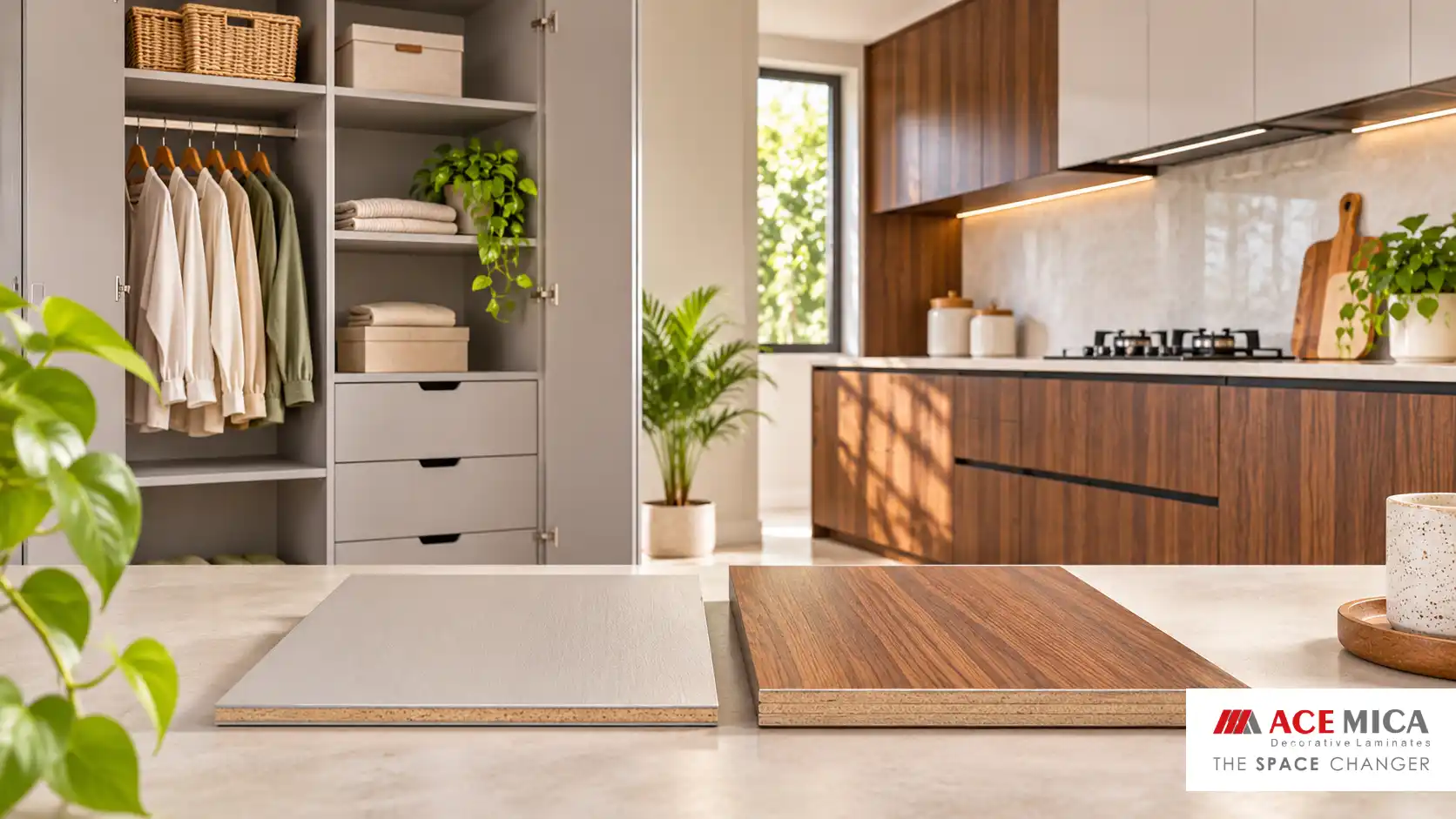
0.8mm laminate is a general-purpose furniture laminate, a little under one millimetre thick, and it works well for wardrobe interiors, shelves, drawer boxes and other surfaces that are touched lightly. It is not the right pick for kitchen shutters, tabletops or any surface that takes daily knocks, where 1mm is the safer choice. This guide shows where 0.8mm makes sense, where it does not and how to decide for your own project.
What does 0.8mm mean on a laminate sheet?
0.8mm means the laminate skin is nominally 0.8 millimetres thick, which is a little thinner than a 1mm sheet. The figure always refers to the laminate alone, not to the board it is pasted on. A finished wardrobe door is many times thicker, because the laminate sits on plywood, MDF or particle board.
The size and thickness guide on this blog describes 0.8mm as the general-purpose furniture grade. That is a fair description. It is thin enough to be economical and flexible enough to wrap and press easily, and it is hard enough to look good on surfaces that nobody leans on. Because catalogue thickness is nominal, read the figure printed against the design and volume you are buying.
Where does 0.8mm laminate work well?
0.8mm laminate works well on interior and low-contact surfaces, where its lower thickness has no visible downside. In most homes that means the inside of a wardrobe, drawer interiors, fixed shelves, back panels, loft doors and guest-room furniture that is used lightly. It also suits rental and short-life projects, where durability over many years is not the main concern.
- Wardrobe interiors, including shelves, partitions and the inside faces of shutters.
- Drawer interiors and the sides of storage boxes.
- Loft and overhead cupboards that are opened occasionally.
- Guest-room and spare-room furniture with light use.
- Display units and decorative panels that people look at but rarely touch.
The reason is wear. A surface that meets hands, elbows and cleaning cloths every day loses its finish first at the edges and corners. A surface that is opened once a week hardly notices the difference between 0.8mm and 1mm, so the saving is real and the risk is small.
Where is 1mm laminate the better choice?
1mm laminate is the better choice for visible shutters, tabletops, kitchen fronts and anything with a deep texture. These surfaces take knocks, repeated cleaning and constant contact, and a sturdier skin handles that for longer. Heavily embossed designs also need enough thickness to keep their relief, so a strongly textured sheet is usually offered in 1mm or above.
Use a simple test. Ask who touches the surface, how often and with what. If the answer is children, cooking, laptops, bags or cleaning staff, move up to 1mm. If the answer is mostly clothes and folded linen, 0.8mm will do. The 1mm laminate sheet guide explains what sits above and below each thickness in the range, and the scratch-resistant laminates guide lists picks for high-traffic areas.
How do 0.8mm and 1mm compare side by side?
The two thicknesses differ in durability, use and cost level, and the right choice follows the use of each surface. The table below gives a practical comparison for common parts of a home.
| Surface | 0.8mm laminate | 1mm laminate |
|---|---|---|
| Wardrobe interior | Suitable, light contact only | Suitable, more than needed for most homes |
| Wardrobe shutter | Possible for lightly used rooms | Preferred for daily use |
| Kitchen shutters and fronts | Not recommended | Preferred |
| Tabletops and study desks | Not recommended | Preferred |
| Drawer interiors and shelves | Suitable | Suitable, higher cost level |
| Textured or fluted designs | Check the design, depth may be limited | Preferred where deep texture is wanted |
Many homes use both. A common split is 1mm on everything visible and 0.8mm on everything hidden, which keeps the surfaces that matter strong and keeps the budget sensible. For a longer breakdown of the trade-offs, see the full 1mm vs 0.8mm laminate comparison.
Does thickness matter more than the board underneath?
No, thickness is only one of three factors, and the board and the pressing often matter more. Moisture resistance, flatness and edge life depend heavily on the substrate, the adhesive and how well the edges are sealed. A 1mm sheet pasted on a weak board will fail before a 0.8mm sheet on a well-made one.
That is worth saying plainly, because buyers sometimes treat thickness as a quality score. It is a use-case choice. Choose the board for the room, choose the adhesive for the board, and then choose the thickness for the touch. The same logic applies on any shop floor: the laminate is one layer of a system.
How do you choose between 0.8mm and 1mm for your project?
List every surface in the project, mark how often it is touched and pick the thickness for each surface separately. This takes ten minutes with a drawing and avoids paying for thickness where nobody will notice it. It also avoids the opposite mistake, which is saving on a tabletop and replacing it two years later.
- Mark each surface as visible or hidden.
- Mark each visible surface as high touch or low touch.
- Give 1mm to every visible, high-touch surface and to deep textures.
- Give 0.8mm to hidden and low-touch surfaces if the design is offered in it.
- Confirm thickness and availability against the design code before you order.
Confirming matters because not every design is made in every thickness. If your favourite design is available only in one, that is useful information in itself, and it may settle the question for that surface.
What mistakes do buyers make with thinner laminate?
The most common mistake is using a thin sheet on a surface that is touched every day, and the second is assuming every design exists in every thickness. A thinner sheet on a kitchen shutter or study desk shows wear at the edges and corners first, and replacing laminate on an assembled unit costs far more than choosing the right sheet at the start. Acemica lists thickness against its catalogue volumes, so the figure can be checked before an order is placed.
- Using 0.8mm on high-touch surfaces because the quote looked lower.
- Assuming a favourite design comes in 0.8mm without checking the design code.
- Mixing sheets from different batches on the same set of shutters.
- Skipping a physical sample and judging colour from a screen.
- Ignoring the board and the adhesive, which matter as much as the sheet.
None of these are hard to avoid. They come down to asking for the thickness, the size and the batch in writing, and to matching the sheet to the job of the surface instead of to a single price.
How should you brief a carpenter or contractor?
Give the carpenter a surface list with a thickness against every line, so nothing is left to guess on site. A simple table with the room, the part, the design code and the thickness avoids most disputes. It also lets you reorder correctly if a sheet is damaged during fitting.
| Room | Part | Design code | Thickness |
|---|---|---|---|
| Kitchen | Shutters and fronts | Your chosen code | 1mm |
| Bedroom | Wardrobe shutters | Your chosen code | 1mm |
| Bedroom | Wardrobe interior | Your chosen code | Per catalogue, thinner if offered |
| Study | Table top | Your chosen code | 1mm |
Ask Acemica for the design codes in writing so the list matches the catalogue exactly, and keep a copy with your sample swatches. When fitting starts, check the first delivered sheets against it before cutting begins.
Frequently asked questions
What does 0.8 mean on a laminate sheet?
0.8 means 0.8 millimetres, the nominal thickness of the laminate skin. It is a little thinner than a 1mm sheet and is generally used as a general-purpose furniture grade.
Is 0.8mm laminate good enough for a wardrobe?
It is good for wardrobe interiors and lightly used shutters. For shutters that are opened many times a day, many buyers prefer 1mm.
Can I use 0.8mm laminate in a kitchen?
It is not the usual choice for kitchen shutters and fronts, because those surfaces are touched and cleaned constantly. Use 1mm there, and use 0.8mm only for hidden interiors if at all.
Is 0.8mm laminate cheaper than 1mm?
It is usually priced lower because it uses less material, but the difference depends on the design, size and quantity. Compare quotes for the same design and sheet size.
Can I mix 0.8mm and 1mm in the same piece of furniture?
Yes, and it is common. Many projects use 1mm for visible surfaces and 0.8mm for interiors, as long as the colours and finish match where the two meet.
Not sure which thickness your design comes in? Send the design code and the use through the contact page and ask for the thickness options. You can also browse designs in the Brown Paper catalogue and the full catalogue. Acemica makes laminates from 0.5mm to 20mm, which includes 0.8mm, and its catalogue volumes are also listed in 0.92mm, 1mm and 1.25mm.