The main types of laminates are decorative high pressure laminates, compact laminates, post forming laminates, exterior grade laminates, colour core laminates, metal laminates and door skins. All of them share the same basic build of resin treated papers pressed into a hard sheet, and each is made for a different job. Choosing the right type matters more than choosing the right design, because a handsome sheet in the wrong grade fails early.
How many types of laminates are there?
There are seven types of laminates that a specifier in India will meet regularly. Acemica lists exactly these seven on its brand page, which makes it a convenient map of the category.
| Type | What it is | Common thickness | Where it belongs |
|---|---|---|---|
| Decorative HPL | Standard laminate glued to a board | 0.8mm to 1.25mm | Furniture, shutters, wall panels |
| Compact laminate | Thick, self supporting laminate | 2mm and above | Restroom cubicles, lockers, counters |
| Post forming grade | Laminate made to bend with heat | Thin, flexible grades | Rounded edges, curved counters |
| Exterior grade | Laminate made for weather exposure | Usually compact thickness | Facades, balconies, outdoor panels |
| Colour core | Laminate with a coloured core | Varies by product | Exposed edges, signage, details |
| Metal laminate | Laminate with a metallic face | Varies by product | Accent panels, feature surfaces |
| Door skin | Door sized laminate sheet | Commonly thinner grades | Flush doors |
The sections below take each one in turn. The thickness column describes common market practice, so check the data for the specific product you are buying.
What is a decorative high pressure laminate?
A decorative high pressure laminate, or HPL, is the standard laminate sheet used on furniture. It is the product most people mean when they say laminate, mica or sunmica.
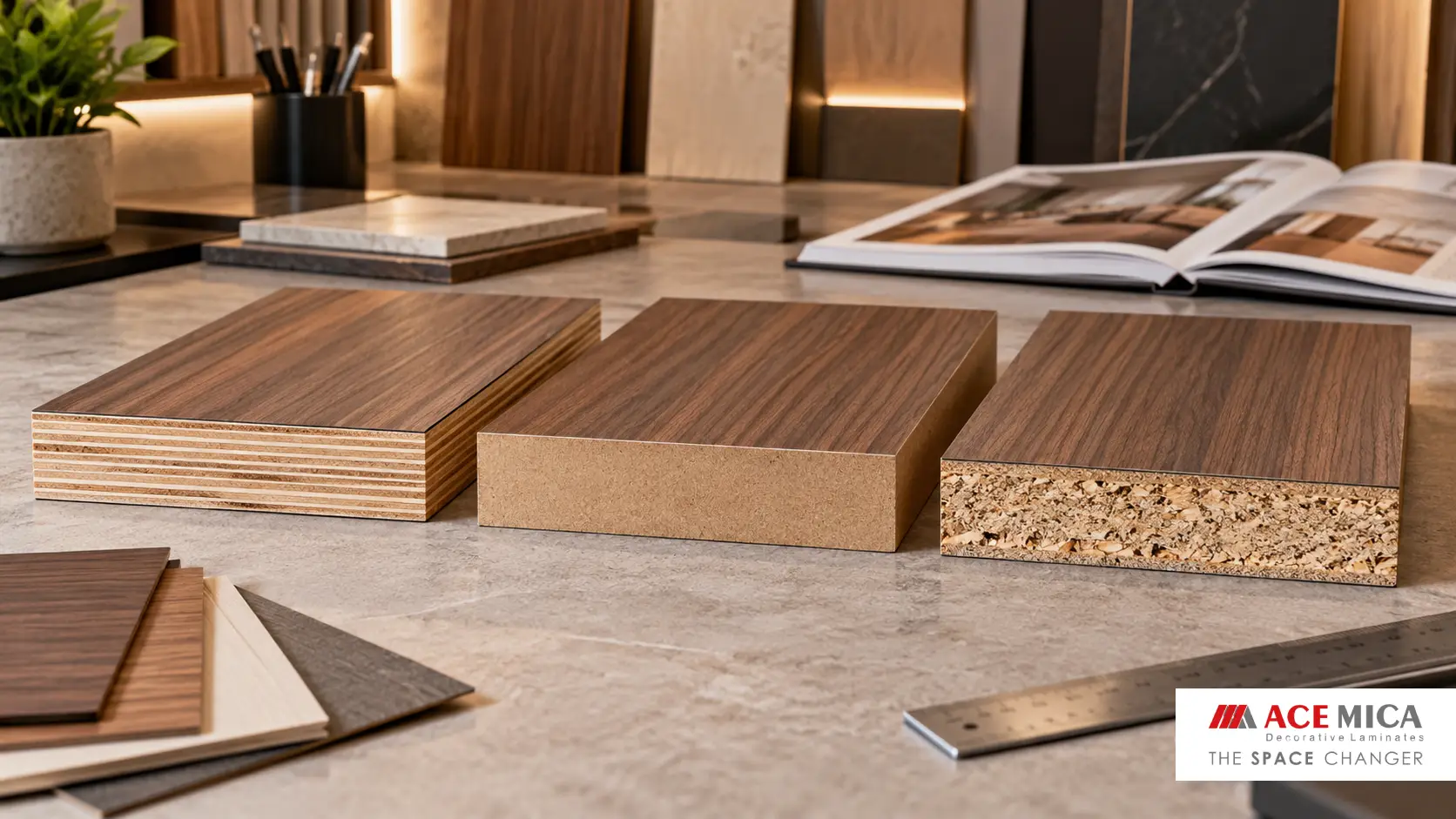
It is made from a decor paper over a kraft paper core and is always bonded to a board such as plywood or MDF. It comes in the widest choice of designs and finishes, and it covers wardrobes, kitchens, tables, wall panels and office furniture. The manufacturing steps are described in how laminates are made, and the two most used thicknesses are compared in 1mm vs 0.8mm laminates.
What is a compact laminate?
A compact laminate is a thick laminate that needs no board behind it. It is built the same way as a standard sheet, with many more core layers, so the result is a rigid panel that can be drilled, machined and fixed directly.
Because there is no wood based core to swell, compact suits wet and heavily used places: restroom cubicles, locker rooms, laboratory furniture and washroom counters. It costs more per square foot than a board with laminate on it, so it is used where that performance is needed. The comparison of compact laminates and decorative laminates goes further into the choice.
What is a post forming laminate?
A post forming laminate is a laminate made to be bent around a curve after it has been manufactured. A standard laminate cracks if you try to wrap it around a tight edge. A post forming grade softens briefly when heated and can be formed over a rounded profile, where it sets again as it cools.
This is how counters and shutters get a continuous rounded front edge with no joint and no edge band. The work is done on post forming equipment under controlled heat, and it is not something to improvise on site with a hot air gun. Specify it when the design has rolled edges, curved reception desks, rounded window sills or bullnose counter fronts.
What is an exterior grade laminate?
An exterior grade laminate is a laminate made to face sun and rain. An interior laminate left outdoors will fade and weather, because its surface was never designed for ultraviolet light and repeated wetting.
Exterior grades are usually made in compact thicknesses and fixed as cladding panels on a sub-frame, with gaps for ventilation and movement. They are used on building facades, balcony panels, gates and outdoor signage. The fixing system matters as much as the sheet, so exterior work should follow the manufacturer’s fixing guidance and be handled by an installer who has done it before.
What are colour core and metal laminates?
Colour core and metal laminates are speciality types chosen for how they look at the edge or at the face.
Colour core laminate
A colour core laminate has a core in a colour close to its face, so a cut edge does not show the usual brown line. Designers use it where the edge is part of the design: floating shelves, display counters, engraved signage and furniture with exposed joints. It pairs naturally with plain colours, as explained in the guide to solid colour laminates.
Metal laminate
A metal laminate carries a metallic layer at its face, giving a brushed, polished or patterned metal look without a metal sheet’s weight. It works best as an accent on vertical surfaces: a bar front, a lift lobby panel, a niche behind a display. It is not the right choice for a hard working table top.
Where do door skins fit in?
Door skins are laminates made in door size with a design composed for a single door. They belong to the same family as decorative HPL and differ in format and layout. The door skin laminates guide covers sizes, design types and fixing.
Which type of laminate suits which application?
The type follows from the application, and the application list is shorter than it seems. Acemica names furniture, doors, storage units, wall panelling, office partitions, interior cladding, exterior cladding and restrooms as the applications for its range. Matched to types, that list reads like this.
- Furniture and storage units. Decorative HPL on plywood or MDF, with a thinner liner inside.
- Doors. Door skins for flush doors, or decorative HPL for tall and custom doors.
- Wall panelling and interior cladding. Decorative HPL on a board, with textured or fluted designs where the wall is a feature.
- Office partitions. Decorative HPL on board for dry areas, compact for partitions that must stand alone.
- Restrooms. Compact laminate for cubicles and vanity counters.
- Exterior cladding. Exterior grade laminate on a ventilated sub-frame.
- Curved counters and rounded edges. Post forming grade.
How do you choose the right type of laminate?
You choose the right type of laminate by answering three questions before you open a design catalogue.
- Will it be glued to a board or stand on its own? Glued to a board means decorative HPL. Standing alone means compact.
- Will it meet water or weather? Occasional splashes are fine for HPL with sealed edges. Constant wetness calls for compact. Sun and rain call for exterior grade.
- Is the surface flat or curved? Flat surfaces take standard grades. Tight curves need post forming grade.
Only then does design come in. Four mistakes turn up repeatedly on sites: an interior laminate used on a balcony, a standard sheet forced around a curve until it cracks, a thin liner used on a shutter face to save money, and compact specified where a laminated board would have done the job for much less.
Frequently Asked Questions
How many types of laminates are there?
There are seven common types of laminates: decorative high pressure laminate, compact laminate, post forming laminate, exterior grade laminate, colour core laminate, metal laminate and door skins. They share the same basic construction and are made for different applications.
What is the difference between HPL and compact laminate?
HPL is a thin sheet, usually around 0.8mm to 1.25mm, that must be glued to a board. Compact laminate is the same material built much thicker, from 2mm upward, so it is rigid and self supporting and needs no board behind it.
What is post forming laminate used for?
Post forming laminate is used where a laminate has to wrap around a curve, such as rounded counter edges, curved reception desks and rolled shutter edges. It softens when heated on post forming equipment and holds the curved shape once it cools.
Which laminate is used for exterior walls?
Exterior grade laminate is used for exterior walls. It is made to withstand sunlight and rain, is usually supplied in compact thickness and is fixed as cladding on a ventilated sub-frame. Interior laminates should not be used outdoors.
What is a colour core laminate?
A colour core laminate is a laminate whose core is coloured to match or complement its face, so cut edges do not show a brown line. It is used for shelves, counters, signage and furniture where the edge stays visible.
Knowing the type first makes every later decision quicker, from thickness to finish to price. Acemica exports its laminates to more than 10 countries and supplies all seven types described here. The complete list of products, sizes and thicknesses is on the Our Brands page, designs can be browsed in the Acemica catalogue, and dealers can be found through the domestic network page.